Gold Coin Errors
Gold coin errors are among the rarest and most sought-after errors in numismatics. Due to the value of the metal and the higher scrutiny given to gold coin production, mistakes involving gold coins are far less common than those seen on base-metal coinage. However, when these errors do occur, they command significant premiums on the market.
High-Value Gold Errors
While many collectors are familiar with common error coins on Lincoln cents or Jefferson nickels, the world of gold coin errors operates on an entirely different level. Even relatively simple errors like broadstrikes — where the coin is struck outside the retaining collar, causing a warped or stretched appearance — can command $15,000 to $30,000 or more when found on U.S. gold coins.
In extreme cases, rare gold error coins such as off-center strikes, double strikes, or die caps have fetched $75,000 to $100,000+ at auction, depending on the coin, type of error, and condition. These prices stand in stark contrast to similar errors on common base-metal coins, which often sell for under $10 in circulated condition.
Why Gold Errors Are Rare
There are a few key reasons why gold errors are so scarce:
-
Gold coin production was heavily monitored due to the high intrinsic value of each blank (planchet).
-
Tighter quality control procedures were applied to gold coin minting compared to base-metal coinage.
-
Many older gold coins with minor striking irregularities may have been melted for their bullion content before collectors even had a chance to see them.
For these reasons, collectors of gold coin errors often have to wait months — and sometimes years — for a notable piece to surface at auction or on the private market. When one does, it is often the highlight of any sale.
What Counts as a Gold Coin Error?
Gold error coins are defined by the same production flaws seen in base-metal coins. These include, but are not limited to:
-
Off-center strikes
-
Broadstrikes
-
Die caps
-
Double or multiple strikes
-
Clipped planchets
-
Struck-through debris or foreign material
-
Misaligned dies
-
Wrong planchet strikes (though extremely rare for gold)
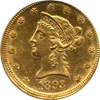
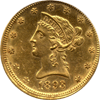
Even a small variation on a gold coin can raise considerable interest. For example, a $10 Liberty struck just 5–10% off-center might easily be worth 10 to 15 times the value of the same error on a copper or nickel coin.
Advice for Collectors
Gold coin errors are a specialty market and tend to attract advanced collectors who have already built extensive collections of regular issue coins. If you are looking to enter this part of the hobby:
-
Work with trusted dealers who specialize in certified errors.
-
Look for coins graded and authenticated by reputable services such as PCGS, NGC, or ANACS.
-
Study auction records to become familiar with realistic values.
-
Be patient — opportunities to acquire legitimate gold errors are rare and often competitive.
Broadstruck Gold Coins
A broadstruck error happens when a coin is struck without the collar that normally holds it in place. This causes the metal to expand and gives the coin a wider, flat, and distorted appearance. On gold coins, this error is extremely rare due to tighter minting controls.
Valuation Chart
Denomination |
Example Year |
Estimated Value Range |
Notes |
|---|---|---|---|
$2.50 Indian |
1911 |
$10,000 – $18,000 |
Very limited examples known |
$5 Liberty |
1898 |
$12,000 – $22,000 |
Broadstrike visible with full detail |
$10 Liberty |
1880s |
$18,000 – $35,000 |
Larger diameter noticeable |
$20 Saint-Gaudens |
1908 |
$25,000 – $50,000+ |
Rare in this size and condition |
Off-Center Strikes
An off-center strike happens when the coin isn’t properly aligned with the dies. On gold coins, the greater the offset and the clearer the visible date, the higher the value.
Valuation Chart
Denomination |
Example Year |
% Off-Center |
Estimated Value Range |
Notes |
|---|---|---|---|---|
$2.50 Indian |
1914 |
10% |
$7,500 – $10,000 |
Full date visible |
$5 Indian |
1912 |
25% |
$12,000 – $20,000 |
Rare with minimal wear |
$10 Liberty |
1881 |
40% |
$28,000 – $45,000 |
Large shift, clear features |
$20 Liberty |
1899 |
15% |
$20,000 – $35,000 |
High collector interest |
Double Strikes
Double struck coins are struck more than once, either overlapping or misaligned.
Valuation Chart
Denomination |
Example Year |
Type of Strike |
Estimated Value Range |
Notes |
|---|---|---|---|---|
$2.50 Indian |
1913 |
Partial |
$9,000 – $14,000 |
Visible doubling, minor shift |
$5 Indian |
1909 |
Shifted |
$18,000 – $25,000 |
Popular collector year |
$10 Liberty |
1892 |
Full |
$30,000 – $50,000 |
Scarce with second full impression |
$20 Saint-Gaudens |
1908 |
Overlap |
$45,000 – $70,000 |
Large denomination premium |
Die Cap Errors
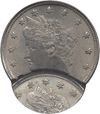
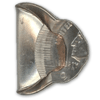
Die cap errors occur when a coin sticks to the die and repeatedly strikes other coins, creating a thimble-like shape. Gold die caps are almost never seen, and examples are fiercely sought after.
Denomination |
Example Year |
Estimated Value Range |
Notes |
|---|---|---|---|
$2.50 Indian |
1910 |
$25,000 – $40,000 |
Deep cap, strong impression |
$5 Liberty |
1901 |
$35,000 – $60,000 |
Few known in private hands |
$10 Liberty |
1890s |
$45,000 – $90,000 |
Rare error in high grade |
$20 Liberty |
1904 |
$65,000 – $120,000+ |
One-of-a-kind sales documented |
Wrong Planchet Strikes
When a gold coin is struck on a planchet intended for a different coin or denomination, the result is a rare and extremely valuable mint error.
Coin Type |
Wrong Planchet |
Example Year |
Estimated Value Range |
Notes |
|---|---|---|---|---|
$2.50 Indian |
Nickel planchet |
1915 |
$30,000 – $45,000 |
Verified auction result |
$5 Liberty |
Dime planchet |
1890s |
$35,000 – $50,000 |
Rare combination |
$10 Liberty |
Silver dollar |
1880s |
$40,000 – $75,000 |
Massive composition anomaly |
$20 Liberty |
Copper planchet |
1900 |
$55,000 – $100,000 |
Ultra rare, few known |
Additional Price Guide Entries:
Wrong Planchet / Off Metal Errors
Additional Price Guide Entries: