
An error coin price guide is a specialized numismatic resource used to determine the market value of coins that were manufactured incorrectly by the United States Mint. Unlike “varieties,” which are caused by a consistent flaw on the die itself, “errors” are typically one-time mechanical mishaps occurring during the striking process. At VarietyErrors.com, our guide provides real-time pricing for major error categories, including off-center strikes, broadstrikes, and double denominations.
Identifying a genuine mint error requires an understanding of the three stages of production: Planchet preparation, Die manufacturing, and the actual Striking of the coin.
Primary Categories of Mint Errors
1. Striking Errors
These occur during the split-second when the dies strike the metal.
Off-Center Strikes: When a coin is struck outside the collar, resulting in a partial design.
Broadstrikes: When the collar fails to deploy, causing the coin to expand outward like a pancake.
Brockages: When a previously struck coin sticks to the die and strikes the next blank, creating a mirror image.
Double Strikes: When a coin fails to eject and is struck a second (or third) time by the dies.
2. Planchet Errors
These errors involve the physical piece of metal (the blank) before it is struck.
Clipped Planchets: Coins missing a curved or straight portion of their metal.
Wrong Planchet Errors: A coin struck on a blank intended for a different denomination (e.g., a Penny struck on a Dime planchet).
Laminations: Cracking or peeling of the coin’s surface due to impurities in the metal alloy.
3. Die Errors
While often categorized as varieties, major die failures are tracked in our error guide.
Cuds: A major break at the edge of a die that results in a raised, design-less “blob” of metal on the coin.
- Die Clashes: When the upper and lower dies hit each other without a blank in between, transferring parts of the design to the opposite die.
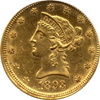
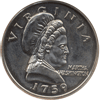
Price Guide Entries:
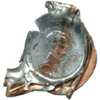
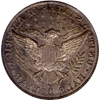
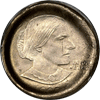
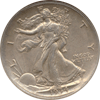
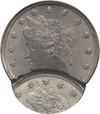
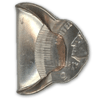
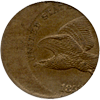
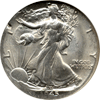
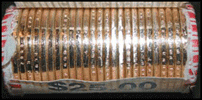
What are Mint Error Coins?
Mint-made errors are errors in a coin made by the mint during the minting process. Groups of coins with distinctive characteristics are known as varieties.
The term variety applies to coins with both intended and unintended differences while the term error refers only to coins with unintended differences. Nevertheless, not all errors are varieties. Although there may be many identical examples of a some errors, others are unique. For example, there may be many indistinguishable examples of coins with a specific die crack, while off-center strikes tend to be unique. Being unique does not mean that an error is valuable.
Although no other coin may be identical to a coin with an off-center strike, off-center strikes happen often enough that buyers can choose from many examples each of which varies slightly from the other.
Mint Errors – Additional Information
Mint error coins can be the result of deterioration of the minting equipment, accidents or malfunctions during the minting process, or intentional interventions by mint personnel. Accidental error coins are perhaps the most numerous and in modern minting are usually very rare, making them valuable to numismatists.
Intentional intervention by mint personnel does not necessarily include a deliberate attempt to create an error, but usually involves an action intended to improve quality that miscarries and creates error coins instead. Errors can be the result of defective planchets, defective dies or the result of mistakes made during striking. The planchet, die, and striking (or PDS) classification system happens to correspond with the mintmarks of the three largest U. S. mints, Philadelphia, Denver, and San Francisco.
Not all errors fall neatly within the categories. Sometimes design elements are missing from coins because dies crevices are filled with grease. Labels used to identify specific categories of errors sometimes describe the cause of the error (die crack, rotated die, clipped planchet). Other errors names describe what the viewer sees when looking at the coin (wavy steps, trails, missing element) while others have names that were adapted for use (mule, cud, brockage).
The result is that some errors are known by multiple names. Filled die errors are also known as missing design element errors and as strike throughs. As is noted below under the discussion of missing design element coins, some errors have multiple causes.
Authentic error coins should not be confused with coins that are damaged after being minted, which is known as post-mint damage (PMD) or post-strike damage (PSD).
Other Coin Errors:
Multi Struck Coins
Uni Face Coins
Fragments
Proofs
Partial Collar Coins
Wrong Planchet / Off Metal Errors
Off Center Coins
Mated Coins
Martha Washington Test Pieces
Indents
U.S. Gold Errors
Fold Overs
Double Denominational Coins
Die Caps
Adjustment Strikes
Brockages
Counterbrockages
Broadstrikes
Bonded Coins
Thanks for visiting Variety Errors and viewing our coin price guide , the online community where
we all come together to answer one another’s questions and give information on error and variety coins to help you grow as a collector.
Along with other great names in the coin world I pull together my resource to give you the best information possible!
Comment, email or private message me any questions or suggestions for videos on coins.
Don’t forget to like and subscribe so we can build the community and stay in touch!