
Die Caps
Die cap errors are some of the most fascinating and complex errors in the world of coin collecting. These pieces are a direct result of an unusual mechanical failure within the coin press during the minting process — and what follows is an extraordinary series of events that results in highly collectible coins.
How Do They Occur?
A die cap occurs when a struck coin sticks to the upper (hammer) die instead of ejecting properly. This adhered coin then acts as a new die face, unintentionally striking subsequent planchets that come through the press.
The result is a secondary class of error — a brockage strike — where the new coins show the incused and reversed image of the stuck coin, instead of being struck with the normal die.
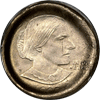
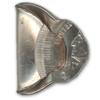
As the original coin remains stuck to the die, it continues to strike more and more coins, and with each successive strike, the metal of the stuck coin is stretched and pushed upward along the shaft of the die. Over time, it forms a hollow, thimble-like shape, essentially wrapping around the upper die itself.
This unusual deformation is the die cap. The more coins it strikes before falling off the die, the taller and more dramatic the cap becomes. These types of errors are extremely rare and often visually spectacular — commanding significant attention from collectors.
Characteristics of Die Caps
Struck Multiple Times: A die cap usually shows a heavily distorted obverse, often with blurred or flattened features due to repeated impacts.
“Thimble” Formation: Higher cap errors take on a cup-like or thimble shape as metal flows up and around the die shaft.
Brockage Counterparts: Coins struck during this event may exhibit a mirror-image reverse, caused by the stuck coin striking new blanks.
Raised Rims: On advanced-stage die caps, the edge of the coin may rise substantially, often appearing much thicker than normal.
Die cap errors are most frequently found on modern copper-plated zinc cents, but they do occur on other denominations. Older or silver die caps are exceedingly rare.
Valuation Chart
Denomination | Early-Stage Cap Value | Late-Stage (High Cap) Value | Notes |
|---|---|---|---|
1 Cent (Modern) | $150 – $400+ | $500 – $1,500+ | Most common die cap errors; high-stage caps attract strong interest |
5 Cent (Nickel) | $300 – $800+ | $1,000 – $2,000+ | Scarcer than cents; clean, full caps highly sought |
10 Cent (Dime) | $350 – $900+ | $1,200 – $2,500+ | Silver die caps (pre-1965) are rare and can exceed $3,000+ |
25 Cent (Quarter) | $500 – $1,500+ | $2,000 – $4,000+ | Higher values for full cups or brockage cap pairs |
50 Cent (Half Dollar) | $1,000 – $3,000+ | $3,500 – $7,000+ | Rare denomination for die caps; often sold at major auctions |
$1 Coin (Modern) | $1,500 – $4,000+ | $5,000 – $10,000+ | Large planchet and dramatic form elevate value; rarely encountered |
Older Series (Pre-1965) | $2,500 – $10,000+ | $10,000 – $25,000+ | Rare due to mint quality control and silver content; highly valuable |
Final Thoughts
Stage Matters: The higher and more developed the cap, the greater the collector interest and valuation.
Paired Pieces: Collectors seek both the die cap and its brockage counterparts; matched sets can be especially desirable.
Authenticated Examples: As with any major error, authentication and grading by a reputable service (such as PCGS or NGC) is recommended to ensure legitimacy and preserve market value.
Spectacle Appeal: These coins are dramatic, unusual, and make great display pieces — often serving as the focal point in advanced error collections.
Die cap errors are one of those minting mishaps that turn into total masterpieces. They’re the perfect storm of mechanical failure and sheer visual wow-factor. What happens is a coin gets stuck to a die—usually the upper hammer die—and stays there. But the press doesn’t stop. Instead, it keeps striking more blanks, and over time, that stuck coin takes on the shape of the die itself, stretching up into a bottle cap or thimble-like shape. The result? A one-of-a-kind coin that’s literally been sculpted by pressure, metal, and time.
These aren’t your everyday errors. Die caps are rare, especially full high-rise examples with dramatic depth. Some show beautifully struck mirror images from repeated hits, while others take on wild, warped forms that look more like art than currency. Either way, they’re standout pieces—pure minting drama caught in the act.
Finding one in circulation? Pretty much a fantasy. These are the kinds of errors that almost never escape notice at the mint. But if you manage to pick one up for your collection, you’ve got something seriously special. They command strong premiums because of their rarity and visual impact—and they’re the kind of piece that makes people lean in and ask, “What on earth happened here?”
Whether you’re building out an advanced error set or just want a serious conversation starter, a die cap is the kind of addition that elevates any collection. A true collector’s trophy—born from chaos, and hard to top.
Additional Price Guide Entries:
Wrong Planchet / Off Metal Errors
Bonded Coins
Additional Price Guide Entries: