Most people glance at a 2013 Lincoln Cent (Shield Penny) and see exactly one cent of purchasing power. To the untrained eye, it is just another copper-colored disc in a jar of pocket change. However, for the serious numismatist and the high-stakes “Registry Set” competitor, a 2013 penny isn’t just currency—it’s a potential four-figure asset.
While billions of these coins were struck, the difference between a “spender” and a “record-breaker” comes down to a razor-thin margin of preservation. If you want to know what a 2013 Shield penny is actually worth, you have to look past the date and into the world of Condition Rarity.
The $3,120 Penny: Why Grade is Everything
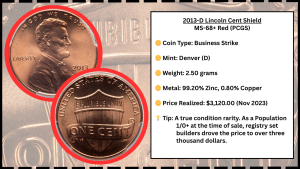
In the modern coin market, value is no longer dictated solely by mintage numbers. The 2013-D (Denver) penny had a massive mintage of over 3.6 billion coins. Logic suggests it should be common—and in most cases, it is. But when a coin achieves a PCGS MS-68+ Red grade, it enters an elite tier of survival.
A 2013-D Lincoln Cent recently sold for an astonishing $3,120.00. This wasn’t because it was made of gold or carried a secret error; it was because of intense registry set competition. High-end collectors compete to have the finest known examples of every year in existence. When only a handful of coins exist in MS-68+ or MS-69, the price ceases to be about the metal and starts to be about the prestige of owning the best.
The ANACS vs. PCGS Price Gap
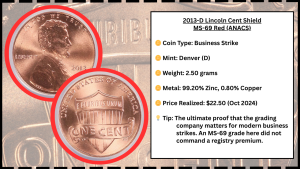
To understand the market, you must be a factual critic of the grading services. Not all holders are created equal in the eyes of the market. Consider this: while the PCGS MS-68+ brought over three thousand dollars, an ANACS MS-69 of the exact same coin (a technically higher numeric grade) sold for a mere $22.50.
This discrepancy highlights a harsh reality for collectors: the market currently places a massive premium on PCGS and NGC “Top Pop” (highest population) coins. If you are hunting for value, the plastic holder matters just as much as the copper-plated zinc underneath.
Technical Specifications: The 2013 Lincoln Cent
Before hunting for rarities, you need to understand the physical makeup of the coin. Every business strike 2013 penny follows these rigid standards:
-
Composition: Copper-plated Zinc (99.2% Zinc, 0.8% Copper)
-
Weight: 2.50 grams
-
Diameter: 19.05 mm
-
Edge: Plain (Smooth)
-
Reverse Design: The Union Shield (representing the states as one inseparable whole)
[INSERT VIDEO EMBED HERE: 2013 SHIELD PENNY VALUE GUIDE]
2013 Union Shield Penny Value Chart
Valuations in the modern market are fluid, but the following realized prices represent the current 2026 market climate for certified examples.
Date/Mint |
Grade & Service |
Price Realized |
2013-D Denver |
PCGS MS-68+ Red |
$3,120.00 |
2013-S San Francisco |
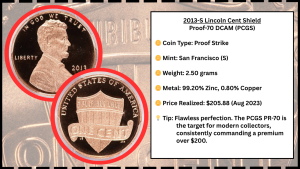
PCGS PR-70 DCAM (Proof) |
$205.88 |
2013 Philadelphia |
PCGS MS-67+ Red |
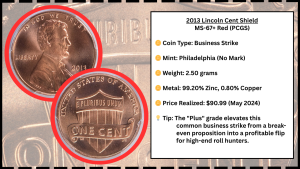
$90.99 |
2013 Philadelphia |
PCGS MS-67 Red |
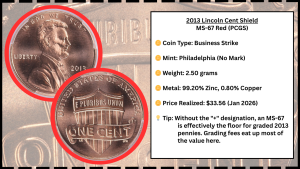
$33.56 |
2013-D Denver |
ANACS MS-69 Red |
$22.50 |
2013-S San Francisco |
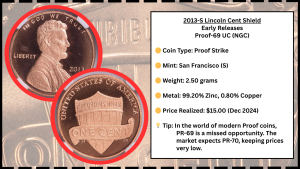
NGC PR-69 UC (Proof) |
$15.00 |
Philadelphia, Denver, and San Francisco: What to Look For
The 2013 “P” (Philadelphia)
Coins struck in Philadelphia do not carry a mint mark. While they are common in high grades like MS-66, the price jumps significantly once you hit MS-67+. To find a winner, look for a “clean” strike with no “carbon spots” (tiny black dots caused by oxidation) and no “planchet bubbles” (gas trapped under the copper plating).
The 2013-D (Denver)
The Denver mint is known for producing billions of coins, but finding one that survived the high-speed bins without a single microscopic scratch is nearly impossible. The $3,120 specimen is an anomaly—a coin that somehow avoided the “bag marks” that plague almost every other 2013-D penny.
The 2013-S (San Francisco)
These are Proof coins, struck specifically for collectors. They were never intended for circulation. While they are visually stunning with mirrored fields and frosted devices, they are only “valuable” if they achieve a perfect PR-70 Deep Cameo (DCAM) grade. If there is even a single hairline scratch visible under 10x magnification, the value drops to around $15.
Is It Worth Grading Your 2013 Penny?
As a factual critic of the hobby, I will tell you: Most of the time, the answer is no. To make money on a modern 2013 penny, you must be certain the coin will grade MS-67+ or higher. Grading fees, shipping, and insurance will cost you approximately $30–$50 per coin. If your 2013-D returns as an MS-66, you have essentially spent $50 to “protect” a coin worth its face value.
Before you ship coins to PCGS, perform a self-audit:
-
Luster: Does the coin have a full “cartwheel” luster?
-
Surface: Are there any black spots or plating bubbles? (These are grade killers).
-
Strike: Is the “2013” and the “Liberty” sharp and well-defined?
The Future of the 2013 Penny Market
As we move through 2026, the Alternative Asset Valuation for modern coins continues to be driven by the digital economy. More collectors are entering the “Registry Set” games via apps and online portals, which keeps the demand for high-grade moderns surprisingly high.
However, remember that these are not “rare” coins in the traditional sense. They are condition rarities. If a hoard of pristine 2013-D pennies were discovered tomorrow in a forgotten bank vault, the current “Top Pop” prices would likely collapse.
Rare Finds and Your Pocket Change
Are you on the hunt for Coins, Star Notes, and Valuable Bills hidden in your Pocket Change? The 2013 penny is just the tip of the iceberg. While you are checking your cents, don’t forget to look at your paper money.
FREE BANKNOTE LOOKUP: Check your serial number rarity at VarietyErrors.com. You might find a Star Note worth hundreds sitting right next to that 2013 penny.
2026 MARKET INDEX: Get the latest Alternative Asset Valuation for your entire collection at VarietyErrors.com.
VarietyErrors
Sign up for FREE News, Videos and Articles!