
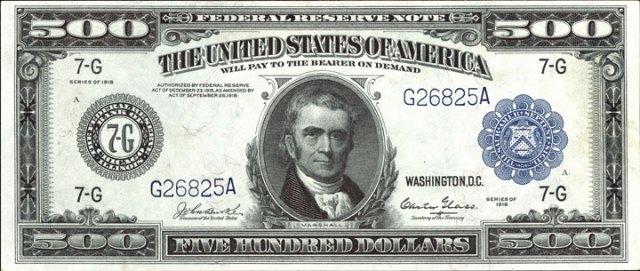
The $500 bill, featuring President William McKinley, is one of the most prestigious notes in American currency history. While technically still legal tender, these notes were officially discontinued in 1969 due to a lack of use in everyday transactions and a desire to curb illegal activities. Today, they are prized museum-quality artifacts.
Unlike smaller denominations, $500 bills were primarily used for large-scale transfers between banks. Because so few were ever in the hands of the general public, any surviving note is considered a significant find.
How Banknotes Are Graded
When dealing with high denominations like the $500 bill, the financial stakes of grading are immense. A single vertical fold can instantly erase thousands of dollars in market value.
-
Average Circulated (VF to EF): Notes in the Very Fine (VF) to Extremely Fine (EF) range show honest use but remain physically sound. They may have limited folds and a semi-crisp surface, but they must have no tears, water damage, or significant stains.
-
Uncirculated (UNC / CU): Also known as “Crisp Uncirculated,” these notes are in factory-new condition. They show no wear, zero fold marks, and possess perfectly SHARP corners.
-
Gem Uncirculated: A “Gem” note is the pinnacle of preservation. It features deep, hard-impressed colors, perfect centering, and an original paper sheen. These notes are the “Holy Grails” of the $500 series and command massive auction premiums.
Pro Tip: Always look for the Star (★) in the serial number. On high-denomination notes, Star notes are incredibly rare because of the low overall print runs.
🔗 Check your $500 Star Note rarity here: Star Note Lookup and Mintage Data
$500 Banknote Valuation Chart (Small Size)
Values are estimated based on average market sales. Rarer Federal Reserve districts like Minneapolis or Boston can bring significantly higher premiums.
Series |
Seal Color |
Note Type |
Circulated (VF/EF) |
Uncirculated (UNC) |
Star Note (UNC) |
1928 |
Gold |
Gold Certificate |
$3,000 – $6,000 |
$10,000+ |
n/a |
1928 |
Green |
Fed Reserve |
$600 – $850 |
$1,250 – $2,500 |
$1,500 – $4,000 |
1934 |
Green |
Fed Reserve |
$600 – $750 |
$800 – $1,500 |
$1,200 – $3,000 |
1934A |
Green |
Fed Reserve |
$600 – $750 |
$800 – $1,500 |
$1,200 – $3,000 |
1934B |
Green |
Fed Reserve |
$3,000 – $4,000 |
$5,000+ |
Rare |
1934C |
Green |
Fed Reserve |
$3,000 – $4,000 |
$5,000+ |
Rare |
The High-Denomination $500 Bill Guide: A Numismatic Icon
The $500 bill, featuring President William McKinley, is one of the most prestigious notes in American currency history. While technically still legal tender, these notes were officially discontinued in 1969 due to a lack of use in everyday transactions and a desire to curb illegal activities. Today, they are prized museum-quality artifacts.
Unlike smaller denominations, $500 bills were primarily used for large-scale transfers between banks. Because so few were ever in the hands of the general public, any surviving note is considered a significant find.
How Banknotes Are Graded
When dealing with high denominations like the $500 bill, the financial stakes of grading are immense. A single vertical fold can instantly erase thousands of dollars in market value.
-
Average Circulated (VF to EF): Notes in the Very Fine (VF) to Extremely Fine (EF) range show honest use but remain physically sound. They may have limited folds and a semi-crisp surface, but they must have no tears, water damage, or significant stains.
-
Uncirculated (UNC / CU): Also known as “Crisp Uncirculated,” these notes are in factory-new condition. They show no wear, zero fold marks, and possess perfectly SHARP corners.
-
Gem Uncirculated: A “Gem” note is the pinnacle of preservation. It features deep, hard-impressed colors, perfect centering, and an original paper sheen. These notes are the “Holy Grails” of the $500 series and command massive auction premiums.
Pro Tip: Always look for the Star (★) in the serial number. On high-denomination notes, Star notes are incredibly rare because of the low overall print runs.
🔗 Check your $500 Star Note rarity here: Star Note Lookup and Mintage Data
$500 Banknote Valuation Chart (Small Size)
Values are estimated based on average market sales. Rarer Federal Reserve districts like Minneapolis or Boston can bring significantly higher premiums.
Series |
Seal Color |
Note Type |
Circulated (VF/EF) |
Uncirculated (UNC) |
Star Note (UNC) |
1928 |
Gold |
Gold Certificate |
$3,000 – $6,000 |
$10,000+ |
n/a |
1928 |
Green |
Fed Reserve |
$600 – $850 |
$1,250 – $2,500 |
$1,500 – $4,000 |
1934 |
Green |
Fed Reserve |
$600 – $750 |
$800 – $1,500 |
$1,200 – $3,000 |
1934A |
Green |
Fed Reserve |
$600 – $750 |
$800 – $1,500 |
$1,200 – $3,000 |
1934B |
Green |
Fed Reserve |
$3,000 – $4,000 |
$5,000+ |
Rare |
1934C |
Green |
Fed Reserve |
$3,000 – $4,000 |
$5,000+ |
Rare |
High-Value $500 Bill Varieties
1. The 1928 Gold Certificate (Gold Seal)
The 1928 $500 Gold Certificate is one of the most beautiful and sought-after notes in the world. They were once redeemable for $500 in gold coin. Because they were recalled in 1933, very few were legally held, and high-grade survivors can easily sell for over $15,000 at major currency auctions.
2. The 1934B & 1934C Rarities
While 1934 and 1934A notes are the “standard” $500 bills seen today, the Series 1934B and 1934C notes are significantly rarer. These series were printed in much smaller quantities for specific Federal Reserve districts. If you have a B or C series, your note is worth roughly 5 to 6 times the value of a standard $500 bill.
3. Light Green Seals (LGS) vs. Dark Green Seals
In the 1934 series, some notes feature a “Light Green Seal.” These were printed earlier in the run and generally command a 10-20% premium over the standard dark green seal notes.
🔗 Is your note a rare run? Find out here: Star Note Lookup and Mintage Data
Click the Denomination Below to See Values
$1 || $2 || $5 || $10 || $20 || $50 || $100 || $500 || $1,000

