
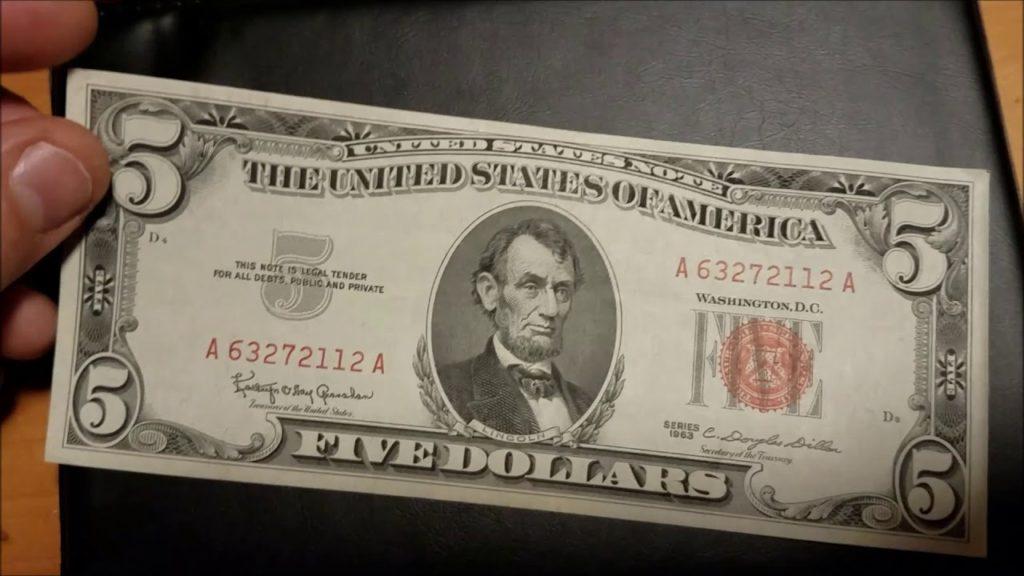
The $5 bill, featuring Abraham Lincoln, is one of the most historically rich denominations in U.S. currency. Since the transition to small-size notes in 1928, the “fiver” has been issued as a Silver Certificate, a United States Note, a Federal Reserve Bank Note, and the standard Federal Reserve Note.
While many $5 bills from the mid-20th century are common, certain seal colors and series letters—specifically the 1928C and 1928D Green Seals—are considered major numismatic rarities worth thousands of dollars.
How Banknotes Are Graded
Condition is the primary driver of value for the $5 denomination. Because these notes circulated heavily, finding “Gem” quality examples from the 1920s and 30s is a challenge for collectors.
-
Average Circulated (VF to EF): These notes have seen moderate use. They contain limited folds and a semi-crisp to crisp surface. To remain in this grade, there must be no tears, water damage, or environmental staining.
-
Uncirculated (UNC / CU): Also known as “Crisp Uncirculated,” these notes are in new condition. They show no wear, zero fold marks, and possess perfectly sharp, square corners.
-
Gem Uncirculated: A “Gem” note is the highest echelon of preservation. It must have all the traits of an Uncirculated note, plus deep, hard-impressed colors and exceptional centering. These bills command massive premiums at auction.
Important: Always check for a star (★) in the serial number. These are Replacement Notes used to replace damaged sheets during the printing process. They are produced in much smaller quantities and are highly sought after.
🔗 Lookup your serial number here: Star Note Lookup and Mintage Data
$5 Banknote Valuation Chart (Small Size)
Values are estimated based on average market sales for notes with standard signatures.
Series |
Seal Color |
Avg. Circulated (VF/EF) |
Uncirculated (CU) |
Star Note (UNC) |
1928 (A-F) |
Red |
$6 – $15 |
$25 – $90 |
$150 – $1,600+ |
1929 |
Brown |
$10 – $200+ |
$100 – $3,000+ |
$10,000+ |
1934 (A-D) |
Blue |
$6 – $12 |
$20 – $45 |
$50 – $285+ |
1934A (Hawaii) |
Brown |
$25 – $50 |
$200 – $600 |
$1,500 – $5,000 |
1934A (N. Africa) |
Yellow |
$10 – $30 |
$190 – $400 |
$450 – $900 |
1953 (A-C) |
Red |
$5 – $8 |
$15 – $30 |
$50 – $80 |
1953B |
Blue |
$5 – $8 |
$18.00 |
$2,500+ |
1928 (A/B) |
Green |
$7 – $35 |
$50 – $100 |
$250 – $900 |
1928C |
Green |
$150 – $650 |
$1,700+ |
RARE |
1928D |
Green |
$200 – $700 |
$2,000+ |
RARE |
1934-1969 |
Green |
$5 – $15 |
$10 – $45 |
$25 – $200 |
1974-1999 |
Green |
$5.00 |
$5 – $10 |
$6 – $40 |
High-Value Varieties to Watch For
1. The 1928C & 1928D Green Seal Rarities
While most 1928-era Federal Reserve Notes are common, the 1928C and 1928D series are “Key Dates” for the $5 denomination. These were printed in extremely small quantities for specific Federal Reserve districts. Finding a 1928D in Uncirculated condition is a major find, with values often exceeding $2,000.
2. WWII Emergency Issues (Hawaii & North Africa)
Like the $1 bill, the $5 bill was issued with special seal colors during WWII to protect the currency’s integrity in combat zones.
-
Hawaii (Brown Seal): Notes overprinted with “HAWAII” to be demonetized if the islands were occupied.
-
North Africa (Yellow Seal): These Silver Certificates were issued to troops in North Africa and Sicily. They are highly collectible, especially in “Star” varieties.
3. The 1953B Blue Seal Star Note
A modern “sleeper” rarity is the Series 1953B $5 Silver Certificate Star Note. While the standard note is worth about $18 in Uncirculated condition, the Star Note version is incredibly rare, often fetching over $2,500 at major auctions.
Identifying Your Note
To determine the value of your $5 bill, you must identify:
-
The Seal Color: Red, Blue, Brown, Yellow, or Green.
-
The Series Year & Letter: Found near the portrait (e.g., 1934A).
-
The Star Symbol: Check if the serial number begins or ends with a (★).
Note: If you find a modern $5 bill (1999–Present) with a star, it may still be worth a premium if it comes from a “Short Run.”
🔗 Check your modern stars here: Star Note Lookup and Mintage Data
Click the Denomination Below to See Values
$1 || $2 || $5 || $10 || $20 || $50 || $100 || $500 || $1,000

