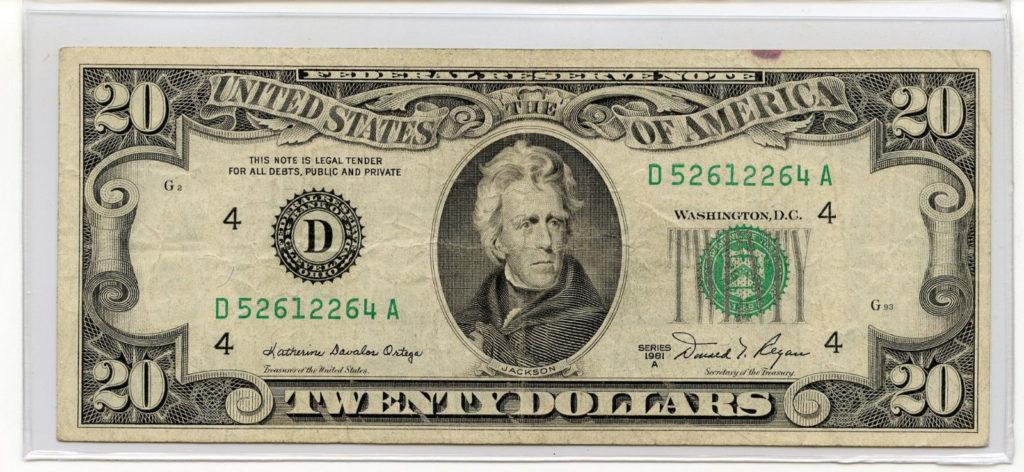
The $20 bill, featuring Andrew Jackson, is one of the most widely circulated denominations in the world. However, in the realm of paper money collecting, the “Jackson” holds secrets that can turn a standard twenty into a multi-thousand-dollar asset. From the 1928 Gold Certificates to the WWII Hawaii Emergency Overprints, the history of the small-size $20 bill is a story of economic shifts and wartime necessity.
While most modern $20 bills are worth only their face value, specific series letters, seal colors, and “Star” replacement marks drive incredible premiums for collectors.
How Banknotes Are Graded
Because $20 bills represent a higher face value, fewer people hoarded them during the Great Depression compared to $1 or $2 bills. This makes high-grade “Gem” examples from the 1928 and 1934 series much rarer than smaller denominations.
-
Average Circulated (VF to EF): These notes show honest signs of use. A Very Fine (VF) note may have several folds and light smudging, while an Extremely Fine (EF) note is nearly new with only 1–3 light vertical folds. Both must have a semi-crisp surface and zero tears.
-
Uncirculated (UNC / CU): Often called “Crisp Uncirculated,” these are flawless. They have never been folded, have zero handling marks, and feature sharp, square corners.
-
Gem Uncirculated: These are the elite “Top Pop” notes. They possess perfect centering, exceptional paper quality (EPQ), and original ink shimmer. Collectors pay massive premiums for Gem-graded notes to complete registry sets.
Pro Tip: Look for the Star (★) in the serial number. These are replacement notes issued in tiny quantities when a sheet is damaged during printing.
🔗 Check your Star Note rarity here: Star Note Lookup and Mintage Data
$20 Banknote Valuation Chart (Small Size)
Values represent market averages. National Bank Notes (Brown Seals) from specific small towns can be worth significantly more than the listed averages.
Series |
Seal Color |
Note Type |
Circulated (VF/EF) |
Uncirculated (UNC) |
Star Note (UNC) |
1928 |
Gold |
Gold Certificate |
$30 – $85 |
$250 – $600 |
n/a |
1928, A |
Green |
Fed Reserve |
$30 – $65 |
$125 – $160 |
$500 – $1,200 |
1928B |
Green |
Fed Reserve |
$20 – $50 |
$75 – $100 |
$400.00 |
1928C |
Green |
Fed Reserve |
$65 – $200 |
$1,000+ |
Rare |
1929 |
Brown |
Nat. Currency |
$22 – $50 |
$120+ |
$250+ |
1934 |
Brown |
Hawaii WWII |
$50 – $150 |
$1,000+ |
$2,000+ |
1934A |
Brown |
Hawaii WWII |
$30 – $60 |
$900.00 |
$2,000+ |
1934-D |
Green |
Fed Reserve |
$20 – $35 |
$40 – $75 |
$300 – $500 |
1950 (A-E) |
Green |
Fed Reserve |
$20 – $25 |
$50.00 |
$300+ |
1963-1995 |
Green |
Fed Reserve |
Face Value |
$25 – $40 |
$35 – $60 |
1999-Pres. |
Green |
Fed Reserve |
Face Value |
$20 – $22 |
$21 – $35 |
High-Value $20 Rarities to Watch For
1. The 1928 Gold Certificate (Gold Seal)
These notes are instantly recognizable by their vibrant Gold Seals and serial numbers. Before 1933, you could walk into a bank and exchange this $20 bill for a $20 gold coin. When the U.S. went off the gold standard, these were recalled, making high-grade survivors highly valuable to history buffs.
2. The WWII Hawaii Overprint (Brown Seal)
Issued after Pearl Harbor, these notes feature “HAWAII” printed on the front and back. Because $20 was a large amount of money in the 1940s, fewer of these were saved in “Uncirculated” condition compared to the $1 Hawaii notes. A “Gem” $20 Hawaii note is a major prize, often fetching over $1,000.
3. The 1928C Green Seal (Key Date)
While most 1928 Federal Reserve Notes are common, the Series 1928C is a difficult variety for collectors. In Uncirculated condition, it is one of the “Key” $20 notes of the small-size era, with values easily crossing the $1,000 mark.
4. Modern Fancy Serials and Star Notes
Modern $20 bills (1990–Present) are usually worth face value, but look for:
-
Radars: Serial numbers like 20200202.
-
Low Serials: Numbers under 00000500.
-
Short-Run Stars: Star notes from print runs of 320,000 or less.
🔗 Lookup your modern Star Note run size: Star Note Lookup and Mintage Data
Click the Denomination Below to See Values
$1 || $2 || $5 || $10 || $20 || $50 || $100 || $500 || $1,000

