
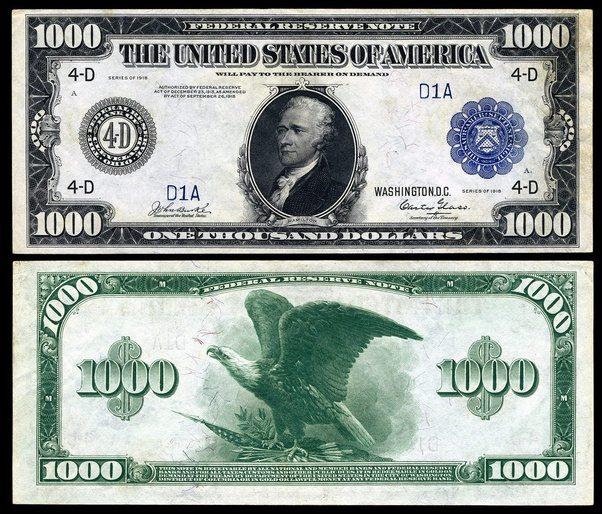
The $1,000 bill is arguably the most famous high-denomination note ever issued by the United States. Featuring Grover Cleveland, these bills were primarily used for high-value inter-bank transfers and real estate settlements before the age of digital banking. While the U.S. government officially stopped printing them in 1945 and began a systematic recall in 1969, they remain legal tender.
Today, a $1,000 bill is a “trophy note” for collectors. Finding one in a high grade is exceptionally rare, as most saw heavy use in the banking system or were destroyed during the Treasury recall.
How Banknotes Are Graded
With a face value of $1,000, the “spread” in price between a circulated and uncirculated note is massive. For high denominations, professional grading (PMG or PCGS) is virtually mandatory to capture the full market value.
-
Average Circulated (VF to EF): Notes in the Very Fine (VF) to Extremely Fine (EF) range are the most common survivors. They have clear folds and some handling wear but must have zero tears, no ink stains, and no pinholes to reach top value.
-
Uncirculated (UNC / CU): Also called “Crisp Uncirculated,” these have never been folded. They possess sharp corners and the original “embossing” (the raised feel of the ink).
-
Gem Uncirculated: These are “Top Pop” specimens. Only a handful of $1,000 bills exist in Gem condition. They feature perfect centering and vibrant ink, often commanding prices in the tens of thousands.
Pro Tip: Look for Light Green Seals (LGS) on 1934 series notes. These earlier printings often have a “lime” color and are considered scarcer than the standard dark green seals.
🔗 Check your $1,000 Star Note rarity here: Star Note Lookup and Mintage Data
$1,000 Banknote Valuation Chart (Small Size)
Values are current market averages. High-grade (Gem) specimens or rare Federal Reserve districts can significantly exceed these estimates.
Series |
Seal Color |
Note Type |
Circulated (VF/EF) |
Uncirculated (UNC) |
Star Note (UNC) |
1928 |
Gold |
Gold Certificate |
$4,500 – $8,500 |
$15,000 – $35,000 |
n/a |
1928 |
Green |
Fed Reserve |
$1,800 – $3,500 |
$5,000 – $12,000 |
$15,000+ |
1934 |
Green |
Fed Reserve |
$1,500 – $2,800 |
$4,500 – $9,000 |
$25,000+ |
1934A |
Green |
Fed Reserve |
$1,500 – $2,800 |
$4,500 – $9,500 |
$20,000+ |
High-Value $1,000 Bill Varieties
1. The 1928 Gold Certificate (Gold Seal)
This is the pinnacle of small-size $1,000 bills. The 1928 $1,000 Gold Certificate features a gold seal and serial numbers. It was redeemable for $1,000 in actual gold coins until the 1933 recall. Because holding these became illegal for a period, very few were saved. Today, even a well-worn example is worth several thousand dollars.
2. Series 1928 Federal Reserve Notes
The Series 1928 Green Seals are much harder to find than the 1934 counterparts. They represent the first year of the small-size format and generally saw more heavy circulation during the start of the Great Depression, leading to a much lower survival rate for high-grade specimens.
3. $1,000 Star (*) Notes
Star notes are replacements for damaged sheets. In the $1,000 denomination, they are extremely rare. A Series 1934 $1,000 Star Note in high grade is a six-figure rarity, with some realizing nearly $100,000 at major currency auctions like Heritage.
4. “Low” Serial Numbers
Since $1,000 bills had low total printage, finding a note with a serial number under 100 (e.g., 00000042) adds a massive “fancy serial” premium, often doubling the note’s base value.
Click the Denomination Below to See Values
$1 || $2 || $5 || $10 || $20 || $50 || $100 || $500 || $1,000

