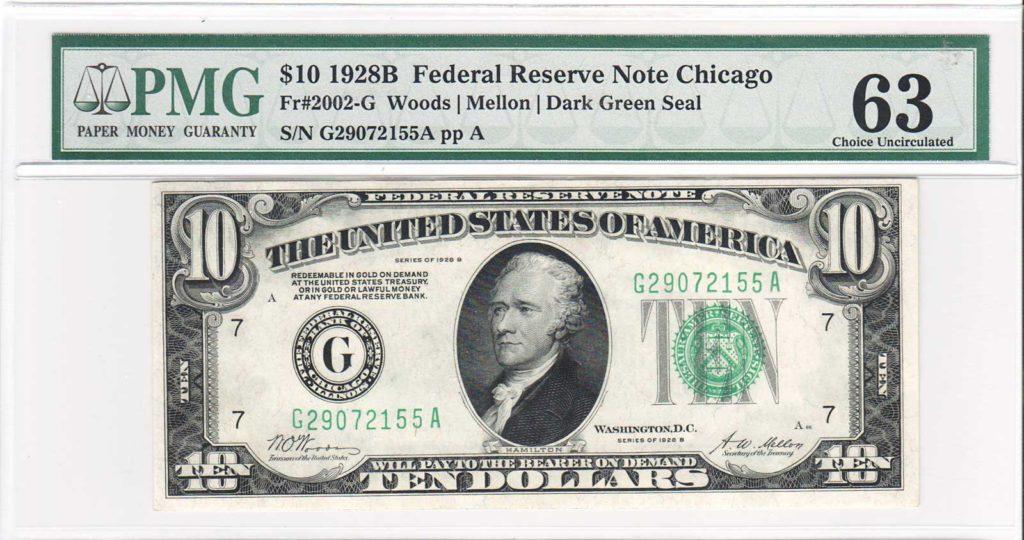
The $10 bill has undergone several dramatic shifts since the 1928 transition to small-size currency. Often overlooked by the general public, the $10 denomination contains some of the rarest and most valuable banknotes in the United States, including the fabled “King of Silvers” and the unique Gold Certificates issued right before the 1933 gold recall.
Whether you have a Blue Seal Silver Certificate, a Yellow Seal WWII Emergency Note, or a Green Seal Federal Reserve Note, this guide will help you determine its true market value.
How Banknotes Are Graded
In the high-stakes world of currency collecting, the difference between an “Average” note and a “Gem” note can be thousands of dollars.
-
Average Circulated (VF to EF): These notes show honest wear. A Very Fine (VF) note may have several folds and light smudging, while an Extremely Fine (EF) note is nearly new with only 1–3 light vertical folds. Both must have a semi-crisp surface and zero tears.
-
Uncirculated (UNC / CU): Often called “Crisp Uncirculated,” these are flawless. They have never been folded, have zero handling marks, and feature sharp, square corners.
-
Gem Uncirculated: These are the elite “Top Pop” notes. They possess perfect centering, exceptional paper quality (EPQ), and original ink shimmer. Collectors pay massive premiums for Gem-graded notes to complete registry sets.
Pro Tip: Look for the Star (★) in the serial number. These are replacement notes issued in tiny quantities.
🔗 Check your Star Note rarity here: Star Note Lookup and Mintage Data
$10 Banknote Valuation Chart (1928–Present)
Values represent market averages for common Federal Reserve districts. Specific banks (like Dallas or Minneapolis) can command much higher prices.
Series |
Seal Color |
Note Type |
Circulated (VF/EF) |
Uncirculated (UNC) |
Star Note (UNC) |
1928 |
Gold |
Gold Certificate |
$20 – $85 |
$400 – $1,200 |
n/a |
1928 |
Green |
Fed Reserve |
$10 – $45 |
$100 – $250 |
$800 – $1,500 |
1928C |
Green |
Fed Reserve |
$20 – $200 |
$200 – $3,000 |
$4,000 – $8,000 |
1929 |
Brown |
Nat. Currency |
$15 – $45 |
$80 – $300 |
$1,500+ |
1933 |
Blue |
Silver Cert |
$800 – $3,500 |
$8,000 – $15,000 |
Extremely Rare |
1934 |
Yellow |
North Africa |
$150 – $2,000 |
$10,000+ |
Rare |
1934 |
Blue |
Silver Cert |
$10 – $25 |
$65 – $150 |
$1,000+ |
1934A |
Brown |
Hawaii WWII |
$25 – $50 |
$250 – $750 |
$2,500+ |
1934B |
Blue |
Silver Cert |
$10 – $35 |
$2,000+ |
$7,500+ |
1953 (A/B) |
Blue |
Silver Cert |
$10 – $30 |
$100 – $250 |
$225+ |
1950-1969 |
Green |
Fed Reserve |
$10 – $20 |
$25 – $70 |
$35 – $200 |
1974-1995 |
Green |
Fed Reserve |
Face Value |
$12 – $20 |
$20 – $40 |
1999-Pres. |
Green |
Fed Reserve |
Face Value |
$10 – $12 |
$11 – $25 |
Major $10 Rarities to Watch For
1. The 1933 $10 Silver Certificate (“King of Silvers”)
This is the holy grail of small-size $10 bills. Only about 156,000 were ever released before the series was abruptly canceled. Most were destroyed by the Treasury. Today, only about 100 specimens are known to exist. If you find a Series 1933 (no letter) blue seal, you are looking at a minimum value of $1,000 even in poor condition.
2. The 1934 Yellow Seal (North Africa)
Issued for the Allied invasion of North Africa (Operation Torch), these notes were designed to be declared worthless if the German army captured them. High-grade uncirculated examples are incredibly difficult to find because most saw heavy military use. A “Gem” quality 1934 Yellow Seal is a five-figure asset.
3. The 1934B Blue Seal (Key Date)
While the 1934 and 1934A Blue Seals are common, the Series 1934B is a massive “key” variety. It is the second rarest $10 Silver Certificate after the 1933. In uncirculated condition, this note jumps from a few dollars to over $2,000.
4. 1928 Gold Certificates
These feature a vibrant Gold Seal and were once redeemable for gold coin. After the Gold Reserve Act of 1934, they were recalled, and many were destroyed. They are distinct because their reverse is printed in standard green, but the obligation on the front specifically promises “Gold.”
Modern $10 Values (Series 1999 to Present)
On modern $10 bills, value is mostly tied to “Star” status or “Fancy Serial Numbers.”
-
Low Serial Numbers: Numbers under 00000100 can be worth $100+.
-
Binary Star Notes: Notes containing only two digits and a star can bring $50–$150.
🔗 Lookup your modern Star Note run size: Star Note Lookup and Mintage Data
Click the Denomination Below to See Values
$1 || $2 || $5 || $10 || $20 || $50 || $100 || $500 || $1,000

